Your baby’s Red Book tracks every weigh-in and vaccination. Teeth tend to get a lot less attention, right up until the night a toddler won’t settle, a six-year-old proudly holds up a wobbly tooth, or a teenager starts asking about braces.
That matters, because tooth decay in children is almost entirely preventable and still very common. In 2024, 22.4% of five-year-olds in England had visible decay. In Yorkshire and the Humber the figure was 27.5%, and in Bradford it’s been measured at around 36%. Tooth decay remains the leading reason children aged 5 to 9 are admitted to hospital in England, usually to have teeth taken out under general anaesthetic.
The good news is that the habits that prevent it are simple, cheap and mostly happen at home. Here’s what to expect, and what to do, at every stage from first tooth to first brace.
Your child’s teeth at a glance
| Age | What’s happening | Your to-do |
| 0–6 months | Teeth developing under the gums | Wipe gums; no sugary drinks in bottles |
| Around 6 months | First tooth, usually bottom front | Start brushing with a smear of fluoride toothpaste; offer a free-flowing cup; book a first dental visit |
| 1–3 years | All 20 baby teeth arrive by about 2½ to 3 | Brush twice a day; dummy away by 12 months; bottle away by the first birthday |
| 3–6 years | Full set of baby teeth in use | Pea-sized toothpaste; ask about fluoride varnish; check-ups every six months |
| 6–9 years | First adult molars arrive; baby teeth start falling out | Ask about fissure sealants; keep helping with brushing until at least 7; gum shield for contact sports |
| Around 7 | Mix of baby and adult teeth | First orthodontic check |
| 10–13 years | Last baby teeth go; 12-year molars arrive | Braces assessment if needed |
| 13–17 years | Adult teeth settling in | Braces if needed; watch sugary and fizzy drinks; independent brushing |
Before the first tooth (0–6 months)
Your baby is born with a full set of 20 baby teeth already forming beneath the gums. There’s nothing to brush yet, but a few early habits make a real difference later:
- Wipe the gums gently with a clean, damp cloth once a day. It gets your baby used to having their mouth cleaned.
- Milk and water only. Never put juice, squash or sweetened drinks in a bottle. Sipping sugar over long periods is one of the fastest ways to decay new teeth.
- Never dip a dummy in anything sweet, such as sugar, honey or jam.
- Look after your own teeth. NHS dental care is free during pregnancy and for 12 months after your baby is born, so it’s a good time to get your own check-up.
The first tooth (usually around 6 months)
Most babies get their first tooth at around six months, though some start before four months and some after their first birthday. Both are normal. Teeth tend to arrive in roughly this order:
| Teeth | Usual age |
| Bottom front teeth | 5–7 months |
| Top front teeth | 6–8 months |
| Top teeth either side of the front two | 9–11 months |
| Bottom teeth either side of the front two | 10–12 months |
| First back teeth (molars) | 12–16 months |
| Canines (pointy teeth) | 16–20 months |
| Second molars | 20–30 months |
Soothing teething
Sore, red gums, extra dribbling, flushed cheeks and chewing everything in sight are all common signs. Cold (not frozen) teething rings, a clean finger rubbed gently over the gum and lots of cuddles all help. If your baby is in pain, sugar-free paracetamol or ibuprofen suitable for their age can be used from three months, and a pharmacist can advise.
One myth worth knowing: there’s no evidence that teething causes fever or diarrhoea. If your baby has either, treat it as a separate illness and get advice.
Start brushing straight away
As soon as the first tooth appears, start brushing twice a day: last thing at night and one other time. Use a small, soft brush and a smear of toothpaste containing at least 1,000ppm fluoride. Check the tube for the ppm number; some “baby” toothpastes contain much less fluoride, or none at all.
Swap the bottle for a cup
From around six months, offer water in a free-flowing cup, one without a valve so your baby sips rather than sucks. Aim to stop using bottles by the first birthday.
Book the first dental visit
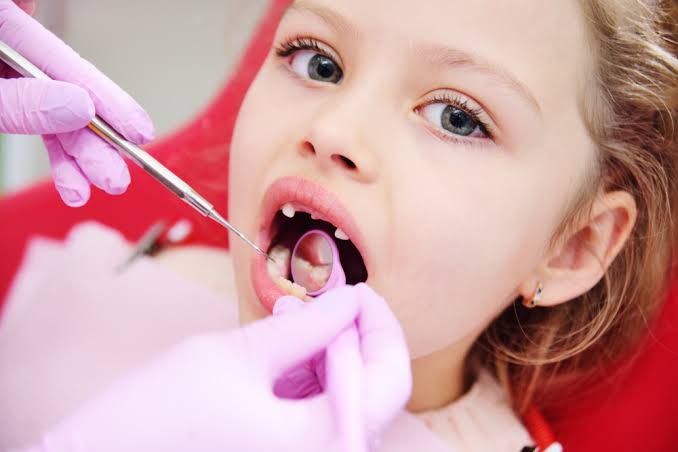
Take your baby to the dentist when the first teeth come through, or by their first birthday at the latest. A first visit is short and gentle: no drills, no injections, and usually your baby sits on your lap while the dentist counts teeth, checks the gums and gives you tailored advice on brushing, diet and dummies.
One easy way to start: bring your baby along to your own check-up first, so the sights and sounds feel familiar before it’s their turn.
Toddler years (1–3)
By around two and a half to three, most children have all 20 baby teeth. This is also the age of the great brushing battle.
Winning the brushing battle
- Make it a routine, not a debate. Same time, same place, every night, ideally as the last thing before bed.
- Let them “have a go” first, then you do the real clean. Toddlers co-operate better when they feel in charge.
- Get the angle right. Sitting or standing behind your child, with their head tilted back against you, lets you see every tooth.
- Use distractions: a two-minute song, a brushing app, or brushing a teddy’s teeth first.
- Spit, don’t rinse. Encourage your child to spit out the extra toothpaste but not rinse with water. Rinsing washes away the fluoride that keeps protecting their teeth overnight.
Dummies
It’s fine to use a dummy, but aim to stop by around 12 months. Using one for longer can encourage an “open bite”, where the front teeth move to make space for the dummy and don’t meet when your child bites together.
Sugar: how often matters more than how much
Every time your child has something sugary, the bacteria in their mouth produce acid that attacks the teeth for up to an hour. A small treat eaten with a meal does far less harm than the same amount nibbled through the afternoon. So:
- Keep sweet foods and drinks to mealtimes.
- Make milk and water the everyday drinks.
- Ask for sugar-free versions of medicines.
- Watch out for hidden sugars on labels: honey, syrups, fruit juice concentrate and anything ending in “-ose” all count.
Preschool (3–6)
From three, step up to a pea-sized amount of toothpaste containing 1,350 to 1,500ppm fluoride, the standard family strength. Keep brushing twice a day, for about two minutes, with the last brush just before bed.
“You brush, then I check”
Let your child brush first so they build the skill, then go over every surface yourself. Children don’t have the dexterity to clean properly on their own until around seven, so plan to keep helping until then at least.
Ask about fluoride varnish
From age three, all children should have fluoride varnish painted on their teeth twice a year. It takes a minute, doesn’t hurt, and strengthens the enamel against decay. Ask about it at your child’s next check-up.
Snack swaps that protect teeth
| Instead of… | Try… |
| Raisins and dried fruit (sticky and sugary) | Fresh fruit with a meal |
| Fruit juice or squash between meals | Water or plain milk |
| Biscuits or cereal bars | Cheese, breadsticks or crackers |
| Fruit yoghurts with added sugar | Plain yoghurt with chopped fruit |
| Sweets as a reward | Stickers, a story or extra playtime |
Check-ups every six months are the norm at this age, though your dentist may suggest a different interval depending on your child’s risk of decay.
Wobbly teeth and the mixed-teeth years (6–9)
The adult tooth most parents miss
Around age six, the first adult molars come through at the very back of the mouth, behind the last baby teeth. No baby tooth falls out to make room for them, so many parents assume they’re baby teeth. They aren’t: these are permanent teeth your child needs for life, and their deep grooves make them especially prone to decay.
Fissure sealants
This is why dentists often recommend fissure sealants at around six or seven. A thin, tooth-coloured protective coating is painted into the grooves of the new molars so food and bacteria can’t settle there. It’s quick, needs no injection or drilling, and is one of the simplest ways to protect new adult teeth.
The gappy stage
Most children lose their first baby tooth, usually a bottom front one, at around six or seven. Over the next few years, gaps, wobbly teeth and big new adult teeth next to small baby ones are all completely normal. New front teeth often look large, slightly yellower than baby teeth and a little crooked at first; many settle as the jaw grows.
You don’t need to see a dentist each time a baby tooth falls out. It can take a few months for the adult tooth to appear, which is also normal.
Keep helping with brushing
Keep brushing with your child, or checking their brushing, until at least age seven. Many children need a reminder and a quick check for longer.
Thumb-sucking
Occasional thumb-sucking is normal in young children. If it carries on as the adult front teeth come through, it can push them forward or stop them meeting properly, so mention it at check-ups and your dentist can suggest the best time and way to stop.
Gum shields for sport
If your child plays rugby, hockey, football or martial arts, a gum shield is worth it. A custom-fitted one made by a dentist fits better and stays in place more reliably than shop-bought versions.
First aid: if a tooth gets knocked out
Baby tooth: don’t try to put it back. You could damage the adult tooth developing underneath. Stop any bleeding with a clean cloth and call your dentist for advice.
Adult tooth: this is an emergency, and speed matters. Pick the tooth up by the crown (the white part), not the root. If it’s dirty, rinse it briefly in milk. If you can, push it gently back into its socket and have your child bite on a clean cloth to hold it. If you can’t, put it in a cup of milk. Then get to a dentist straight away.
The age-7 orthodontic check
The British Orthodontic Society recommends that children have a first orthodontic check by around age seven. At this age there’s a mix of baby and adult teeth, which shows how the jaws are growing and whether there’s likely to be enough room for the adult teeth.
A check at seven doesn’t mean braces at seven. Most children are simply monitored at their regular check-ups. A small number benefit from early treatment while the jaw is still growing.
Signs worth mentioning to your dentist:
- crowded or overlapping teeth, or very large gaps
- top front teeth that stick out a long way
- bottom teeth that bite in front of the top teeth
- front teeth that don’t meet when your child bites together
- the jaw shifting to one side when they bite
- baby teeth lost much earlier or later than their friends’
- thumb-sucking that continues past age five or six
Tweens and teens (10–17)
By around 12 or 13, most children have lost their last baby teeth and their second adult molars, the “12-year molars”, have come through. Wisdom teeth, if they arrive at all, usually come much later, in the late teens or twenties.
When do children need braces?
Most braces are fitted between about 11 and 15, once most adult teeth are through and the jaw is still growing. Your dentist will usually advise on timing at routine check-ups, building on that first check at seven.
Are braces free on the NHS?
NHS orthodontic treatment is free for under-18s, but only where there’s a clear clinical need. Dentists measure this with the Index of Orthodontic Treatment Need (IOTN), which grades problems from 1 (little need) to 5 (great need). Children generally qualify with a score of 4 or 5. Mild crowding or small gaps that are mainly cosmetic usually don’t. NHS treatment is normally with fixed metal braces, and your dentist has to refer you to an orthodontic provider.
If your child doesn’t qualify, or you’d prefer different options, private treatment is available. At Eccleshill this includes fixed braces and removable appliances, always followed by retainers to hold the teeth in their new position.
Looking after teeth in braces
- Brush carefully around every bracket, morning and night, and use small interdental brushes to clean under the wire.
- Avoid hard, sticky and chewy foods that can break brackets, such as toffee, hard sweets, whole apples bitten straight into, and crusty bread.
- Keep fizzy drinks to a minimum. Sugar and acid trapped around brackets can leave permanent white marks on the teeth when the braces come off.
- Wear retainers exactly as instructed. Teeth naturally try to drift back, and retainers are what keep the result.
Teenage habits that matter
- Fizzy, sports and energy drinks are acidic as well as sugary, and can wear away enamel. Water is still the best everyday drink.
- Bleeding gums when brushing are an early sign of gum inflammation, not a reason to brush less. Brush more gently and more thoroughly, and mention it at the next check-up.
- Mouthwash can help, but only as an extra. If your dentist recommends a fluoride mouthwash, use it at a different time from brushing, such as after lunch, so it doesn’t rinse away the toothpaste’s fluoride.
Paying for children’s dental care
NHS dental treatment is free for children under 18, and for under-19s in full-time education. If you can find an NHS practice with space, that’s the most affordable option, and the NHS website lists local practices accepting new patients.
Many families find NHS places hard to get, though, and some prefer the flexibility of private care. Children’s dental plans spread the cost into a monthly payment. As a worked example, here’s what Eccleshill Dental’s children’s membership plans include:
| Age | Monthly cost | Includes |
| 0–5 years | £5.95 | Two check-ups a year; X-rays when needed |
| 6–11 years | £6.95 | Two check-ups and two fluoride applications a year; X-rays when needed |
| 12–15 years | £8.85 | Two check-ups and two fluoride applications a year; X-rays when needed |
| 16–17 years | £9.95 | X-rays when needed; ask the practice for full details |
Members also get 50% off core dental treatments. Whichever route you choose, the important thing is that your child is seen regularly.
When to call the dentist between check-ups
Don’t wait for the next routine appointment if you notice any of these:
- toothache, or your child avoiding chewing on one side
- swelling of the gum or face, or a pimple-like bump on the gum
- white, brown or black spots on the teeth that weren’t there before
- a chipped, broken or knocked-out tooth, or a tooth that has turned grey after a knock
- a baby tooth that’s very wobbly with the adult tooth already showing behind it
- bleeding gums that don’t settle within a couple of weeks of better brushing
- sensitivity to cold drinks or sweet foods
A knocked-out adult tooth, or swelling with a high temperature, needs to be seen urgently. Call your dentist straight away, or NHS 111 out of hours.
Your next step
You don’t need to remember every age and stage in this guide. If you get the basics right, most problems never start: fluoride toothpaste twice a day, sugar kept to mealtimes, a helping hand with brushing until at least seven, and regular check-ups from that very first tooth.
If you’re looking for a children’s dentist in Bradford, Eccleshill Dental sees children from their first tooth through to their teens, including nervous children, fissure sealants, fluoride varnish and orthodontic assessments.
Children’s dental care FAQs
Is fluoride toothpaste safe for babies?
Yes, in the right amount. A smear of toothpaste with at least 1,000ppm fluoride is recommended for under-threes, and a pea-sized amount from age three. That small amount gives strong protection against decay. Supervise brushing so your child doesn’t eat toothpaste from the tube.
Do baby teeth really matter if they fall out anyway?
Very much. Baby teeth help children eat, speak clearly and smile with confidence, and they hold space for the adult teeth. Some back baby teeth aren’t lost until around age 12, so decay in them can mean years of pain or infection, and losing them early can cause adult teeth to come through crooked.
When do children need braces?
Most children who need braces have them fitted between 11 and 15. A first orthodontic check is recommended by around age seven, though most children are only monitored at that stage.
Are braces free on the NHS?
For under-18s with a clear clinical need, yes. Eligibility is judged using the Index of Orthodontic Treatment Need, and children generally qualify with a score of 4 or 5. Mainly cosmetic problems usually aren’t covered.
Are fissure sealants worth it?
For most children, yes. Sealants protect the deep grooves of the new adult molars, where decay often starts, and they’re quick and painless to apply with no drilling.
What if my child is scared of the dentist?
It’s common, and a good children’s dentist will go at your child’s pace. Start visits early so the practice feels familiar, avoid words like “hurt” or “needle” beforehand, and let the dental team know about any worries when you book. Bringing children to your own check-ups first can help too.